June 22, 2026
Bloat and GDV in Great Danes: Warning Signs Every Owner Must Know
If you own or are considering owning a Great Dane, there is one medical condition you must understand before anything else. Gastric Dilatation-Volvulus — commonly called bloat or GDV — is a life-threatening emergency that affects Great Danes at one of the highest rates of any breed. It can kill a healthy dog within hours. Knowing the warning signs and acting immediately can mean the difference between life and death.
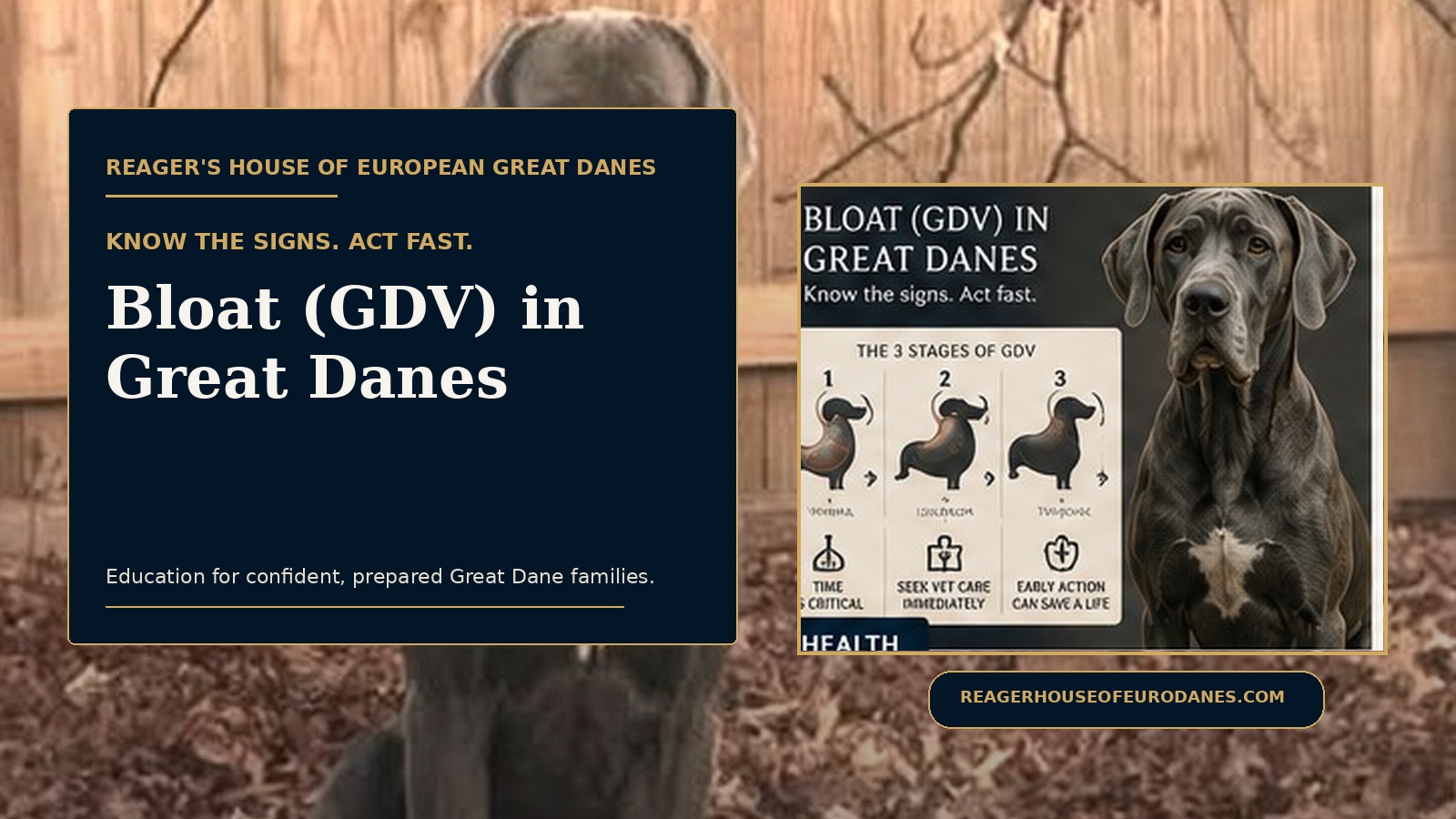
This article is for educational purposes. If you suspect your dog is experiencing GDV, do not wait — go to an emergency veterinary clinic immediately.
What Is Bloat and GDV?
Bloat in its simplest form is the accumulation of gas in the stomach, causing it to expand. In many dogs this resolves on its own or with veterinary treatment. The far more dangerous progression is GDV — gastric dilatation-volvulus — in which the expanded stomach twists on itself, trapping the gas inside and cutting off blood supply to the stomach, spleen, and surrounding tissues.
Once torsion occurs, the condition becomes rapidly fatal without emergency surgical intervention. The stomach tissue begins dying within minutes to hours. Even with immediate surgery, survival rates range from 75% to 85% depending on how quickly treatment begins and how far the condition has progressed.
Why Great Danes Are at High Risk
Deep-chested breeds — those with a chest that is tall and narrow relative to body width — are disproportionately affected by GDV. The stomach in these dogs has more physical room to rotate when gas accumulation creates instability. Great Danes, along with Standard Poodles, Weimaraners, Saint Bernards, and Irish Setters, are consistently identified as among the highest-risk breeds in veterinary research.
Studies have estimated that a Great Dane has approximately a 40% lifetime risk of developing GDV. This is not a rare condition for the breed — it is a real and ever-present risk that every Great Dane owner must take seriously.
Warning Signs of Bloat and GDV
Recognizing the signs early is critical. Do not wait to see if symptoms improve. The progression from bloat to full GDV can happen within minutes.
Early warning signs:
- Restlessness and inability to get comfortable — pacing, lying down and getting back up repeatedly
- Unproductive retching — attempting to vomit but bringing nothing up, or producing only foam
- Distended abdomen — the belly appears visibly swollen or feels tight and drum-like when tapped
- Excessive drooling
- Anxiety, whining, or obvious distress
Advanced signs indicating torsion has likely occurred:
- Pale or white gums
- Rapid, shallow breathing
- Weakness or collapse
- Cold extremities
- Rapid heart rate
If you observe any of these signs — especially unproductive retching combined with abdominal distension — treat it as an emergency and go directly to the nearest emergency veterinary clinic. Do not call first. Drive and call from the car.
Prevention Strategies
While GDV cannot be completely prevented in at-risk breeds, there are well-supported management strategies that reduce risk:
- Feed multiple small meals. Instead of one large meal per day, feed two to three smaller meals. This reduces the volume of food and gas in the stomach at any one time.
- Restrict exercise around meals. Do not allow vigorous exercise for at least one hour before and one hour after eating. This is especially important for puppies and young adults.
- Avoid elevated food bowls. Research has shown that elevated bowls — once recommended for giant breeds — are actually associated with increased GDV risk in large and giant breeds. Feed your Great Dane from a bowl on the floor.
- Slow feeder bowls. Dogs that eat very quickly swallow more air, increasing bloat risk. A slow feeder bowl or puzzle feeder can reduce eating speed.
- Avoid stress around feeding times. Dogs that are anxious or excited at mealtimes may eat faster and swallow more air. Calm, routine feeding environments help.
- Know your nearest emergency vet. Have the address and phone number of your nearest 24-hour emergency veterinary clinic saved in your phone before you ever need it.
Prophylactic Gastropexy
A gastropexy is a surgical procedure in which the stomach is permanently attached to the abdominal wall, preventing it from rotating even if it fills with gas. The procedure does not prevent bloat but completely eliminates the risk of torsion — the deadly part of GDV.
Many veterinarians recommend prophylactic (preventive) gastropexy for Great Danes, ideally performed at the time of spay or neuter to avoid a second surgery. This is a conversation worth having with your veterinarian early in your dog’s life. The surgery is routine, recovery is straightforward, and the peace of mind it provides for a breed at this level of risk is significant.
What We Tell Every Reager’s House Family
Before every puppy goes home, we walk new owners through GDV risks, warning signs, and prevention strategies. We recommend locating an emergency vet before your puppy arrives home, discussing gastropexy with your veterinarian at the first wellness visit, and never ignoring unproductive retching in a Great Dane at any age.
This is one of the realities of owning a giant breed. The joy they bring is immeasurable — and being prepared is simply part of responsible ownership.